
In the earliest days of the web, Derek Powazek set out to create a website meant for sharing.
Thornforms is a somewhat unusual font, even for a dingbat.
It was designed in the ’90’s by Marcus Burlile, who had some quiet success as a type designer over his career. His work includes the font face Able, which was used for chapter titles and page numbers in the Harry Potter series. Thornforms has every bit of Burlile’s typical boldness and illustrative style, a set of offbeat characters arranged imaginatively, and mapped to each letter.
Thornforms caught the attention of Derek Powazek in 1996, not long after he bought the domain name fray.com. Even though the web was barely in its infancy, Powazek already had some good experience with it. He worked at HotWired, laying out designs for Dave Winer’s regular column there. Over the years, Powazek would continue to be an influence on the web, working at places like Technocratic and Blogger (and even designing the soon-to-be ubiquituous “B” logo for blogger).
At the time, however, Powazek was growing disillusioned with his work at HotWired and started to look at what else he could do on the web. He bought the fray domain without having a full idea of what it could be, though he knew it would centered around personal storytelling, drawn from contributors all around the web.
He did what I think any of us would do. He typed out the site name using this strange and whimsical font face, just to see what happened. The letters F RA Y in Thornforms looks like this:
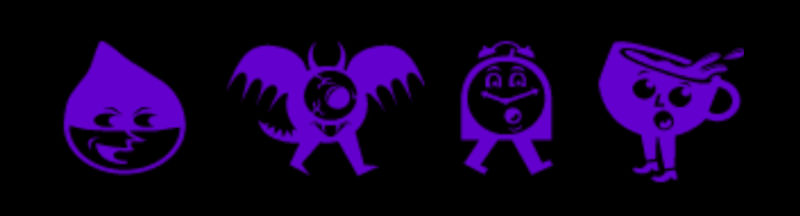
And then the idea clicked. The illustrations he saw typed out gave him a way to ground and group the stories he wished to collect. He selected four themes, each named for one of the symbols from the site’s Thornforms set namesake: criminal, hope, work, and drugs. ” I knew the critical mass of stories in each section would define that section more than any word or pictogram,” he once told Jeffrey Zeldman in an interview, “And they’re each loose enough to contain any story that comes along.” Each theme would be filled with entries from around the world, sharing a bit of their own personal story.
In Septmber of 1996, fray.com went up on the web. It collected stories from whomever wished to contribute, as along as they followed a few ground rules. Stories had to (at least loosely) fit one of the themes for the site. They had to be honest, and written in the first person, and be less than a thousand words. Other than that, stories could be about anything or anyone. Stories were each designed and laid out according to their content, and no two stories had the same design.
The first story to kick it off was called “stoked,” and it’s a pretty good example of the type of thing the fray would soon become popular for. It’s a brief bit of personal storytelling by Powazek himself, about what the amazement and wonder he felt at first walking into the HotWired offices, immersed in a world that had as much passion for the web and technology as he did. And how it eventually turned sour, one staggering deparature after another from what once made it great. The story opens on a webpage composed of just two sentences and an image.
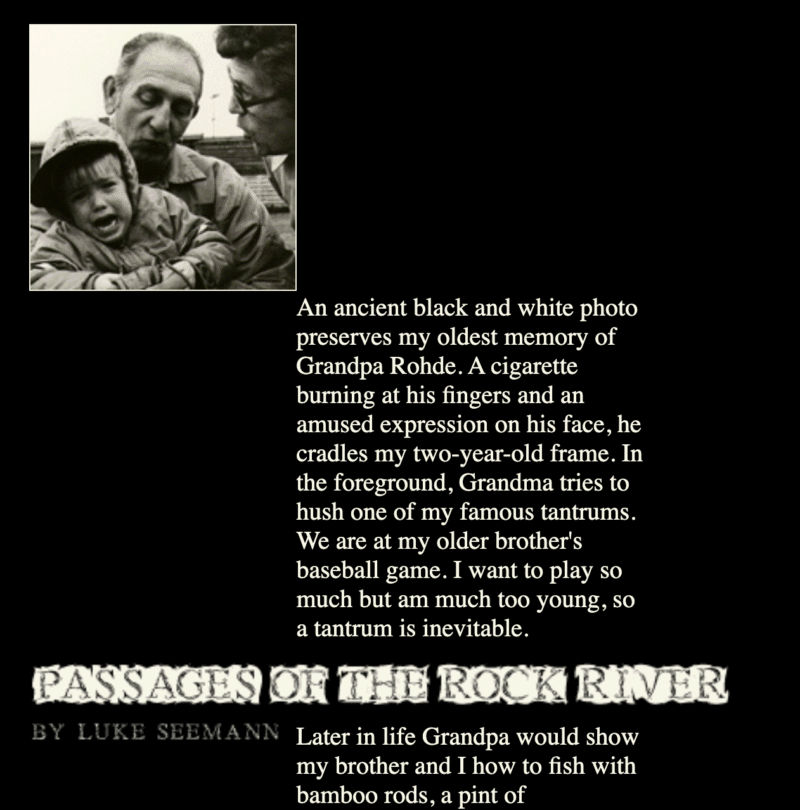
Clicking through each sentence takes you to the next one, until the fully story is revealed, itself arranged alongside images and portraits from Powazek’s past. Stoked was followed by the same kind of personal and immersive stories from others, accruing a massive following on the web along the way.
Two years later, Powazek sat on a stool in front of a crowd of and played them a few songs from his guitar. He had taken center stage at the fray’s second birthday party, which had prompted him to invite regular contributors and visitors to Fray to a warehouse in San Francisco for the event. Around 150 people showed up. It took the form of an open mic, and Powazek himself kicked things off with his guitar. But others followed him, one by one, until a full evening passed of people sharing stories, telling jokes, playing songs, and connecting with one another.
“In many ways, this was the real test of fray – to see if what we built here, from behind the safety of this glass, could survive out in the open,” Powazek said in the days following the event. In those days, there were still concerns about the separation between the “real world” and the online world. But many people, including many who visited the fray, didn’t see that distinction. The web was about connection, after all, and any chance to connect in the real world only expanded what was possible on the web.
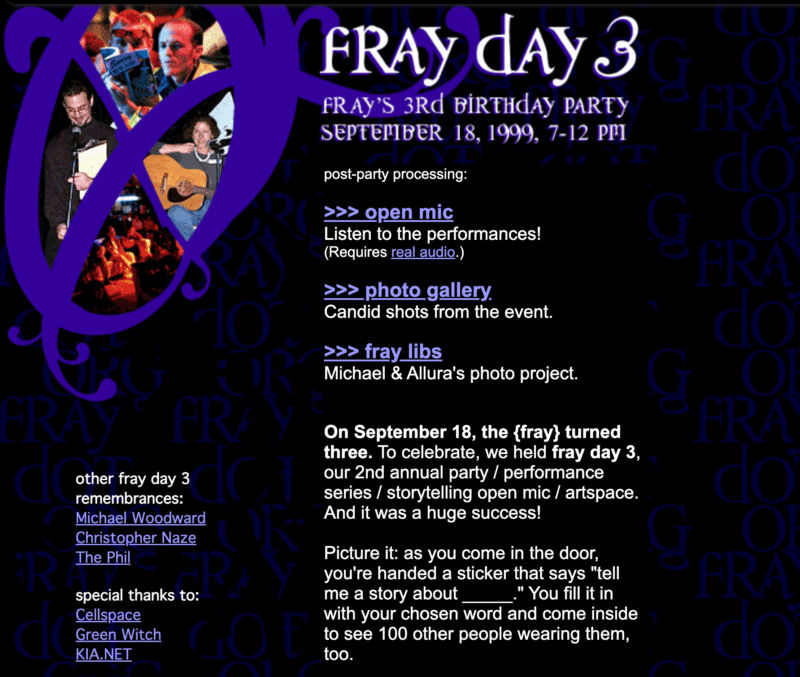
By the following year, the fray was more popular than ever. Powazek tapped into that growing community with the Fray Foundation, an organization meant to run real world events just like the site’s second birthday party. It’s first major event was the fray’s third party, by now dubbed “Fray Day.”
Fray Day would run for years, and spin off into other smaller gatherings and events. People coming together to tell stories from their lives with strangers, bonded only by an initial connection on the web. It spawned a massive community of people, and led to countless magical interactions. In the lead up to Fray Day, Powazek was interviewed about what the web meant to him, and where he wanted it to go. He had this to say.
And the web? Frankly I hope it doesn’t change one bit. So long as ordinary people can put their voices online for a negligible cost, I’ll always love it.
P.S. In honor of the Fray, I’ve gone ahead and tried to make this short. I made it under a thousand words. Just barely.
Sources
- Jeffrey Zeldman. "Jeffrey Zeldman Presents: The Daily Report." Jeffrey Zeldman Presents. August 8, 2026. https://zeldman.com/daily/0802c.html#evangeline
- Bruce Sterling. "Information Wants to Be Worthless." The Austin Chronicle Screens. August 8, 2026. http://web.archive.org/web/20030207080858/http://www.austinchronicle.com/issues/dispatch/2002-03-01/screens_feature2.html
- Martin Sunnerdahl. "Unedited Derek M. Powazek interview, April 5, 1999 – I Wish It Was More Sordid." Unedited Derek M. Powazek interview, April 5, 1999 – I Wish It Was More Sordid. August 8, 2026. https://www.sunnerdahl.org/ms/2006/03/unedited-derek-powazek-interview-april-5-1999/
- Kathryn Dudding. "Out of the Fray: Storytelling Web site Morphs into a Magazine – National Storytelling Network." National Storytelling Network - National Storytelling Network. August 8, 2026. https://storynet.org/out-of-the-fray-storytelling-web-site-morphs-into-a-magazine/
- mathowie. "Derek put some photos from the Fray Day online,." Derek put some photos from the Fray Day online,. August 8, 2026. https://www.metafilter.com/240/Derek-put-some-photos-from-the-Fray-Day-online
- Derek Powazek. "the fray 2nd bday." the fray. 2026. http://web.archive.org/web/20011101101149/http://www.fray.org/bday/

Leave a Reply