
Permalinks are commonplace on the web. But it took the rise of blogging to codify them, and bring them out into the world. And it all started with a single exchange of blogs.
Blogging at prolific.org creates some expectations, which Caroline Van Oosten lived up to. She blogged at a rapid clip, a blend of links, comments, and drop-ins on her inner monologue in short spurts. “I wish my dad had a business so I could build him a site like Jeffrey Zeldman did for his father,” a typical post might look. Blogging was her way to think out loud. Van Oosten was prolific, and she was always paying attention.
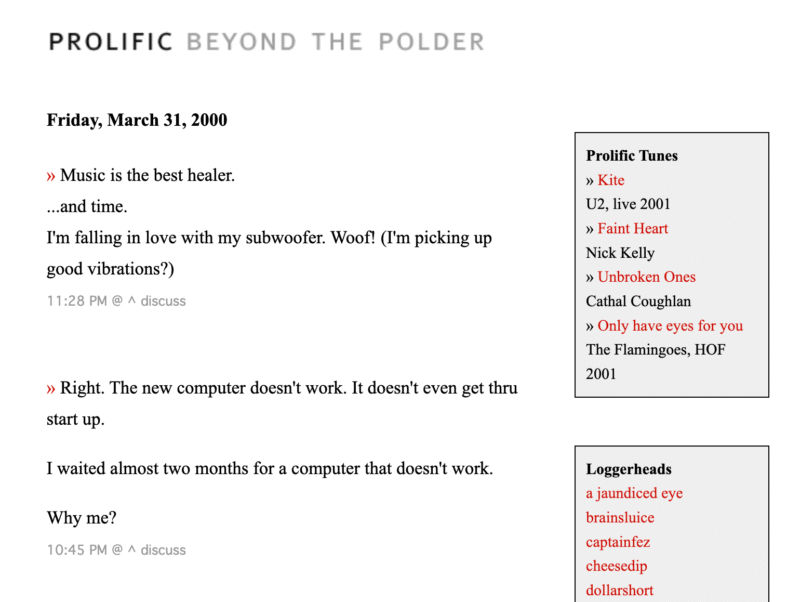
In March of 2000, she pulled up Jason Kottke’s blog, one of those that was permanently pinned on the sidebar of prolific.org’s blogroll. Even in the blogosphere’s earliest days, Kottke.org was something of an institution. Avid web surfers of the day were sure to stop by the site at least a couple of days a week.
“Finally. Did you notice the little icon next to today’s date,” read the note on that particular day, at the end of his list of notes for the day that included a tongue in cheek reference to the 5k web design competition, suggesting a “5 bytes” contest instead. His blog was formatted not unlike Van Oosten’s blog, staccato thoughts thematically linked only in that they interested their creator. “It links to the permanent URL for this entry. Use that URL to bookmark or link to this particular entry,” the note concluded.
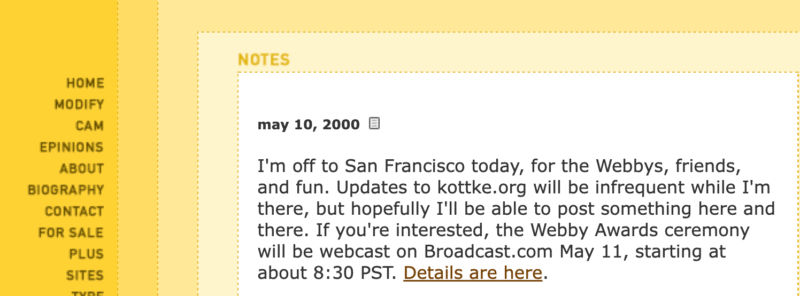
Kottke had managed to add permanent links on his blog, next to each entry posted in his archives. Linking to monthly archives was something that had been around for quite some time. But the ability to link to an individual entry was something pretty novel. It made sense to point it out, with a bit of pride, hoping others would take notice.
Van Oosten noticed. As a user of the blogging platform Blogger, that wasn’t something she could do. Of course, she had to post about it on prolific.org, noting it in a parenthetical hanging off the end of another thought.
2000 is going to be the year of web design minimalism. 5k anyone? Or perhaps 5 Bytes… (by the way, Jason implements the feature I’d love to see in Blogger: persistent references).
A couple of hours later, Van Oosten blogged again, this time about something else. But Matt Haughey, who was still working at Blogger for a brief stint before leaving to work on Metafilter full time, did notice what had been posted. In fact, he had just spent some time over that past weekend with Blogger colleagues Evan Williams and Paul Bausch. They had noticed the icon on Kottke’s blog too. How could they not?
But in their case, Bausch thought he might have a solution, which he shared with Haughey. Haughey took to his own blog the same day of Van Oosten’s post to explain. There was a bit of code that people needed to add to their blogs, using an <a name tag that assigned each entry in the archives a unique ID. In combination with a link to an archived month you could create a complete link reference, something like http://BlogName.org/archive/2000_03_01_index.shtml#12345.
Van Oosten took notice of the circular reference. And of course, she had to respond herself.
Anyway, thanks Matt for the tutorial on persistent links… (soon to be known as the Haughey Manoeuvre) – I think pb told me how to do this a while back but I forgot and am lazy, Jason’s icon brought it all back. And anyway, that doesn’t work if it’s in the archives does it? Or does it? Oh Matt says it does. Aha. Of course
Over the next couple of weeks, she watched as the idea spread around. People began picking it up on their own Blogger blogs, adding in the code to create the persistent and permanent links. By the end of March, Bausch had followed up on the Blogger blog with a much more detailed explainer, and an official guide to making it work.
Hey! Where did that post go? Good question. Here’s the answer: Permanent Links.
When exactly permanent links became permalinks is lost to history, but it wasn’t long after that. And that’s how permalinks got started.
Leave a Reply