
In 1998, Bruce and Susan Abelson launched Open Diary. Building on personal site builders like Geocities, Angelfire, and Tripod, Open Diary let people create personal diary pages, which where then collected on the sites homepage. The purpose of Open Diary was visibility. Each diary entry was meant to be shared and discovered by others.
The Ableson’s were no strangers to discovery, or to the web. They ran a web design agency for early web adopters. And on the side, they ran a community site for their local township in New Jersey, Somerset Hills. The Ableson’s maintained the Somerset Hills website for several years, adding information about schools, local news, and events in their neighborhood. They even added a public bulletin board and classifieds sections. It was a sophisticated use of relatively modern tools at the time, meant to connect digitally people in their local community.
That same focus drove the creation of Open Diary, which is often credited as the first website with a comment section. That’s up for some debate, but it is true that Open Diary had one of the earliest and certainly most public version of comments. Diaries that were hosted on the site had a “Notes” section where other visitors could login and drop a reflection or thought on a particular diary entry. Authors could, in turn, respond to those comments.
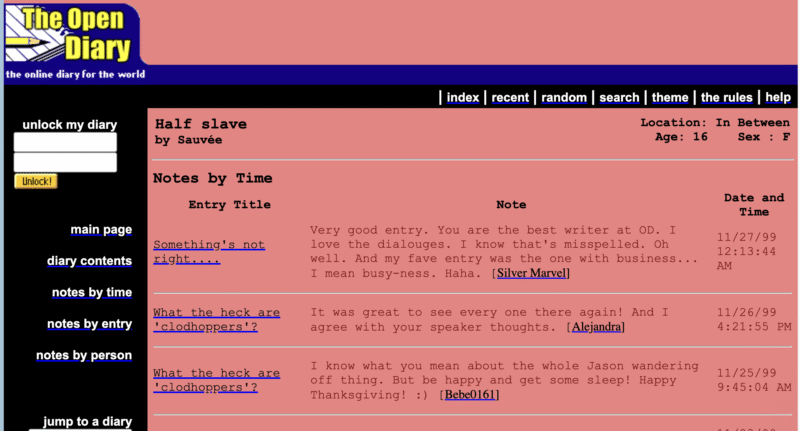
However, notes were relegated to a separate page at first, and lacked threaded discussion. In some ways, the notes section on Open Diary lay somewhere between formal comments and a guestbook. Guestbooks were not all that new as a concept. The first one on the web popped up on the collaborative blog Fray.com in 1996. By 1998, they were fairly commonplace on personal sites. Well-versed in the community tools of the time, the Ableson’s almost certainly knew this. They extended that one step further and began to move the web towards comments. But they were also building on a long legacy of community minded technology that predated the web itself.
From the very beginning, the bedrock of the Internet and other major networks was its community. The first linked networks, like Prodigy and CompuServe, offered message boards and forums based around interests and topics. AOL thrived by the fortune of its chat rooms.
When the Internet began to spread, it did so via BBS and Usenet groups that brought people from around the world together in discussions with one other. Popular communities like Echo and the WELL gave people refuge and a sense of belonging. The Internet always felt most impressive and staggering when it demonstrated an ability to connect people hundreds and thousands of miles away with each other.
This is what inspired Tim Berners-Lee to create the World Wide Web in the first place, and inspired the design for it. On the web, anybody can link to anybody. That was a fundamental principle. But Berners-Lee went even further when he helped create Interactive Talk, experimental forum software created for the web.
It was the webs first form based discussion systems, but it wouldn’t stay that way for long. In 1996, Ted O’Neill took forums even further into a full scale product when he built the Ultimate Bulletin Board (or UBB) software. UBB provided rich discussions that could be hosted on virtually any web server. The history of forums has its own richness, which I’ll be following up on sometime soon. But it was safe to say that UBB had all the markings of online discussions that would be familiar today, both in terms of format and design.
All of this served as a backdrop for Open Diary. The Ablesons drew from decades of innovation and connection. When they introduced the ability to drop notes on diaries, it was a logical leap, and a creative one.
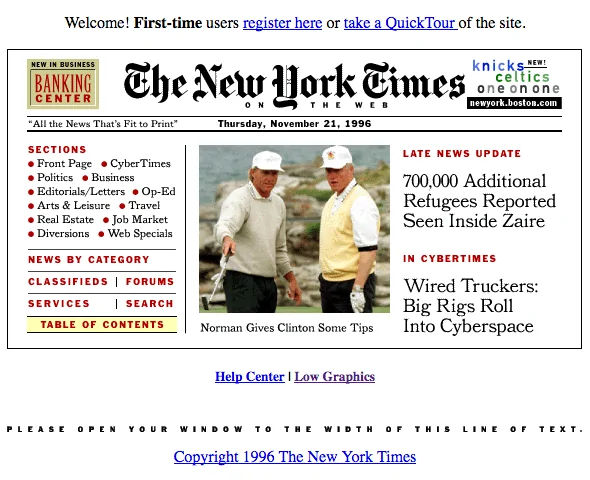
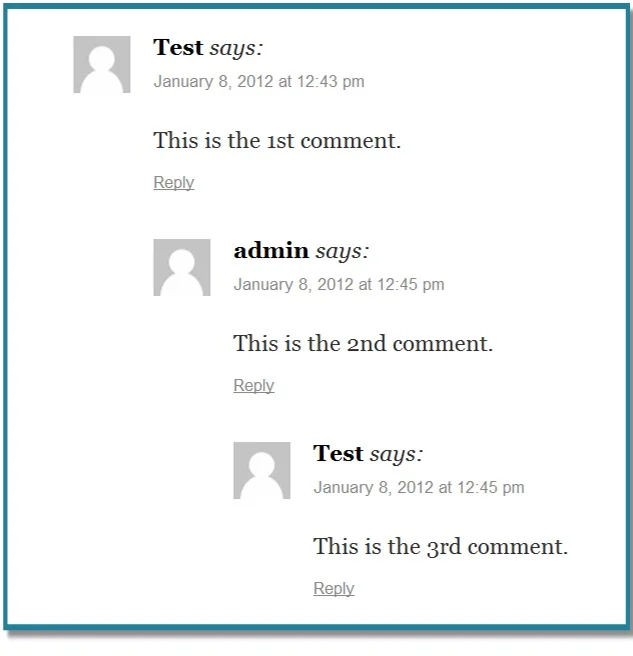
That led to more innovation. Notes, renamed to comments, began popping up on personal sites and blogs, pinned to the bottom of posts instead of a page off to the side. Over time, the functionality became more refined. There were avatars next to the comments, and threaded replies built right in. New blogging tools like WordPress and Movable Type had comments built right in, and added trackbacks as a way of extending them. By the end of 1998, comments moved to news publications as well, starting with a regional newspaper called Rocky Mountain News.
In some ways, comments were a natural extension of letters to the editor and reader responses, something most publications, especially newspapers, had been doing for decades. Even before there were official comments sections, readers would email in to journalists and writers with thoughts, or post to public message boards to generate a bit of a discussion around this article or that.
Comments are a good example of deliberative spaces, places where productive discussions can, and often do, happen. These are spaces that are intentionally modeled to discuss and produce creative solutions, even from those with opposing opinions or ideologies. They are places of disagreements but also widened perspectives and ideological engagement.
This was especially true in news articles and blogs, were commenters were engaging with a specific idea, and in comment sections where writers and journalists chose to join in, setting a tone and expectation for productive discussion. It brought the audience of the work into the work itself.
Which is what led Jeff Atwood to make a very specific claim in 2006. A blog without comments is not a blog. His point was that without comments, without intentionally deliberative spaces, a blog was simply a place to broadcast your ideas, nothing more than a pulpit. Comments provided a way for everyone to participate, the true nature of a blog. And that was a relatively popular sentiment around this time.
But others were advising some level of caution. Atwood was in part responding to a blog post written by Jeremy Keith, comments on community. In it, Keith identifies an unfortunate trend. “There seems to be an inverse relationship between popularity and the usefulness of accompanying comments.” In other words, as comments sections grew, they became less useful and more prone to toxic, hateful and counter-deliberative discussions. He pointed out that comments are great when the topic of blogs is more narrow, and the blogger is directly engaged. But in the context of broad and widely popular communities, they had the capability to fester.
This was a prescient observation. As the web continued to grow, the issue grew. Without dedicated moderation, which many publications did try, comments sections became discordant and a liability. Around the time of Jeremy’s post, the Washington Post was one of the first publications to remove comments, citing a lack of civility.
It took some time for others to catch up. In 2013, Popular Science published a long summary of why they were shutting down their comments. They specifically researched an emerging field of research that demonstrated how even a small percentage of toxic or offensive comments could drive people away.
Many other publications joined Popular Science in their move. By 2015, Wired published a rundown of the sites that had removed comments. And they soon followed, with hundreds of others. The reasons varied, from the emergence of social media, where conversations would often take place instead, to the growth of comments that was difficult or untenable to moderate.
That trend has continued, as many sites chose to outsource discussions to social media platforms and third party networks. For sites that can manage comments, it is done through careful moderation and clear rules. But most major publications and platforms have simply opted out.
Comment sections continue to exist, but their presence is far diminished from its peak. The ActivityPub standard, the backbone of the Fediverse, was created as a partial response to their decline. Whether or not comments will find some new form is a story still unwritten. Maybe they just need a few creators like the Ableson’s to remix them into something proper and new.
Sources
- Klint Finley. "A Brief History of the End of the Comments." WIRED. October 10, 2025. https://www.wired.com/2015/10/brief-history-of-the-demise-of-the-comments-timeline/
- "Just a moment…." Inevitable/Human. October 10, 2025. https://inevitablehuman.com/the-complicated-history-and-frightful-future-of-the-internet-comment-section/
- Gina Masullo Chen and Paromita Pain. "NORMALIZING ONLINE COMMENTS." Journalism Practice. October 10, 2025. https://paromitapain.com/wp-content/uploads/2019/12/Normalizing-Online-Comments.pdf
- BBC Trending. "Is it the beginning of the end for online comments?." BBC News. October 10, 2025. https://www.bbc.com/news/blogs-trending-33963436
- JEFFREY BROWN. "Post Web Site Halts Comments Section." PBS News. October 10, 2025. https://www.pbs.org/newshour/show/post-web-site-halts-comments-section
- Shane Richmond. "What is a blog? How the technology shapes the medium." The Telegraph. October 10, 2025. https://web.archive.org/web/20120606135752/http://blogs.telegraph.co.uk/technology/shanerichmond/8173527/What_is_a_blog_How_the_technology_shapes_the_medium/
- Arthur D Santana. "Online Readers’ Comments Represent New Opinion Pipeline." Online Readers' Comments Represent New Opinion Pipeline. https://www.academia.edu/6528209/Online_Readers_Comments_Represent_New_Opinion_Pipeline

Leave a Reply