
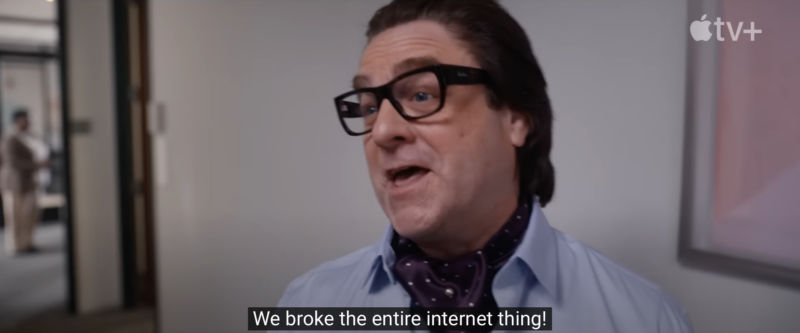
The new Beanie Bubble movie (available on Apple TV) documents the rise and epic fall of the Beanie Baby craze of the 1990’s. Beanie Babies are notable for their website, the first true “e-commerce” site. The year was 1995, before the likes of Amazon and right around the time eBay was founded. The site spawned a viral movement that had not been seen before. In the movie, the company’s CEO first goes into a tirade over people who would “pirate” his website’s images and photos, before realizing the benefits of rapidly spreading information online which prompts a laugh-out-loud one-liner.
One corner of my research has me looking at a wave of blogging that started to build in the early 2000’s, in the wake of the dot-com crash and in the build-up to the Iraq war. In September 2000, blogger Rebecca Blood wrote a first draft of that new history in weblogs: a history and perspective.
What struck me was how simple and how powerful the basic premise was:
The blogger, by virtue of simply writing down whatever is on his mind, will be confronted with his own thoughts and opinions. Blogging every day, he will become a more confident writer. A community of 100 or 20 or 3 people may spring up around the public record of his thoughts. Being met with friendly voices, he may gain more confidence in his view of the world; he may begin to experiment with longer forms of writing, to play with haiku, or to begin a creative project–one that he would have dismissed as being inconsequential or doubted he could complete only a few months before.
Blogging for personal enrichment. What a concept.
I’m reading through Thomas Pynchon’s Crying of Lot 49 and it features this absurd and morbid aside:
How did the post horn come in? That went back to their founding.In the early ’60’s a Yoyodyne executive living near L.A. and located someplace in the corporate root-system above supervisor but below vice-president, found himself, at age 39, automated out of a job. Having been since age 7 rigidly instructed in an eschatology that pointed nowhere but to a presidency and death, trained to do absolutely nothing but sign his name to specialized memoranda he could not begin to understand and to take blame for the running-amok of specialized programs that failed for specialized reasons he had to have explained to him, the executive’s first thoughts were naturally of suicide.But previous training got the better of him: he could not make the decision without first hearing the ideas of a committee.
The absurdity of the high-level executive has been a reality for quite some time. It reminds me of some conversations happening around A.I. in the service of “efficiency.” Almost 60 years later, and we may actually be able to automate C.E.O.’s out of a job.
I’ve been digging into the invention of what’s sometimes called “Netscape Time,” the rapid acceleration of software development once it moved to the web thanks to digital access to that software. But Netscape Time also was often chaotic and without purpose. When Jamie Zawinski (one of the original programmers on the Netscape team) left the newly spun out Mozilla in 1999, he had this to say:
And there’s another factor involved, which is that you can divide our industry into two kinds of people: those who want to go work for a company to make it successful, and those who want to go work for a successful company. Netscape’s early success and rapid growth caused us to stop getting the former and start getting the latter.
Which is to say, the failure of a lot of companies that have come since.
When the wizards of the web met
Published: August 1, 2023
On July 28, 1993, a group of web pioneers met in a small room for a few days. For many, it was the first time they had ever met.
The crash that ended it all
Published: July 5, 2023
The Crash When the pieces began to fall in the early months of 2000, it happened quick. “It was the […]
The Dot-com surge
Published: June 20, 2023
As the dot-com hype began to rise, entrepreneurs and ordinary investors got swept up in the fervor.
From the valley to the alley
Published: May 24, 2023
The Flatiron building is one of the most instantly recognizable buildings in New York City. Built at the beginning of […]
The web’s most important decision
Published: April 30, 2023
I got a bit caught up this month, so I had to delay a couple of things, but I’ll be […]
Dot-Com Part 1: Burning up
Published: March 24, 2023
Chapter 11: Dot-Com is live! Part 1 at least. I’m going to be sending out this chapter over the next couple […]
Reading about the dot-com era
Published: February 21, 2023
There is a lot out there about the dot-com bubble, and its subsequent burst. I tried to limit the scope […]
History of the Web, the First 10 Chapters
Published: February 7, 2023
This is it! As of today, I’ve put all of the chapters I’ve written up on it’s own site. I’ve also […]